WRI Aqueduct Water Risk
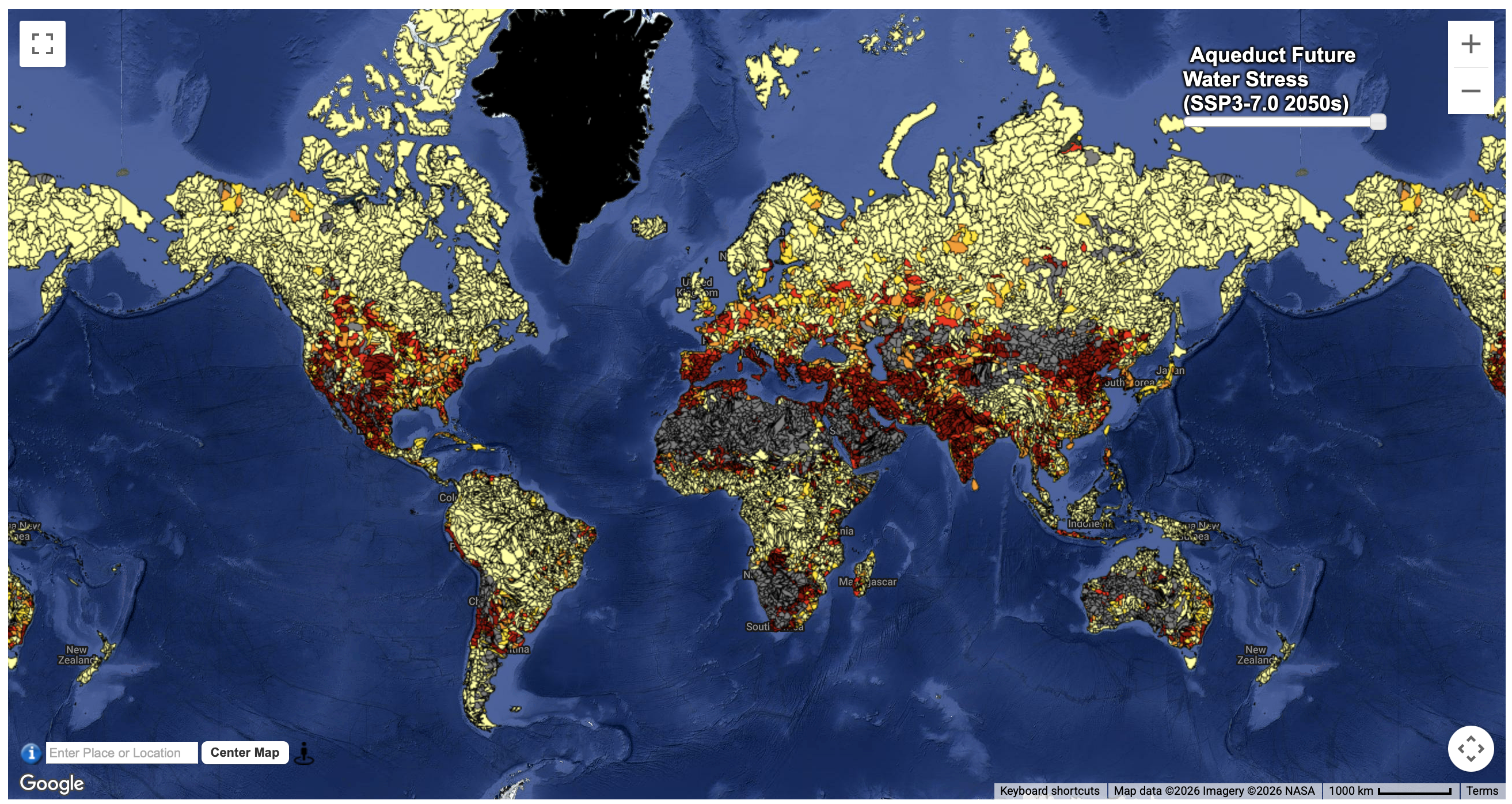
Description
Aqueduct 4.0 is the latest iteration of WRI's water risk framework designed to translate complex hydrological data into intuitive indicators of water related risk. This dataset has curated 13 water risk indicators for quantity, quality and reputational concerns into a comprehensive framework. For 5 of the 13 indicators, a global hydrological model called PCR-GLOBWB 2 has been used to generate novel datasets on sub-basic water supply. The PCR-GLOBWB 2 model is also used to project future sub-basin water conditions using CMIP6 climate forcings. The projections center around three periods (2030, 2050, and 2080) under three future scenarios (business-as-usual SSP 3 RCP 7.0, optimistic SSP 1 RCP 2.6, and pessimistic SSP 5 RCP 8.5).
The water risk indicators have been aggregated by category (quantity, quality, reputational, and overall) into composite risk scores using sector-specific weighting schemes. In addition, select sub-basin scores have been aggregated into country and provincial administrative boundaries using a weighted average approach, where sub-basins with more demand have a higher influence over the final administrative score.
The WRI Aqueduct baseline annual dataset provides a comprehensive overview of water-related risks on an annual basis which includes indicators such as baseline water stress, baseline water depletion and interannual variability. This annual data is essential for understanding long-term trends in water risk, assessing the cumulative impacts of human activities on water resources, and developing long-term water management strategies.
Organization
World Resources Institute
Website
Terms of Use
The WRI datasets are available without restriction on use or distribution. WRI does request that the user give proper attribution and identify WRI, where applicable, as the source of the data.