Treatment Response Groups (TRG) Fuel Treatments
Description
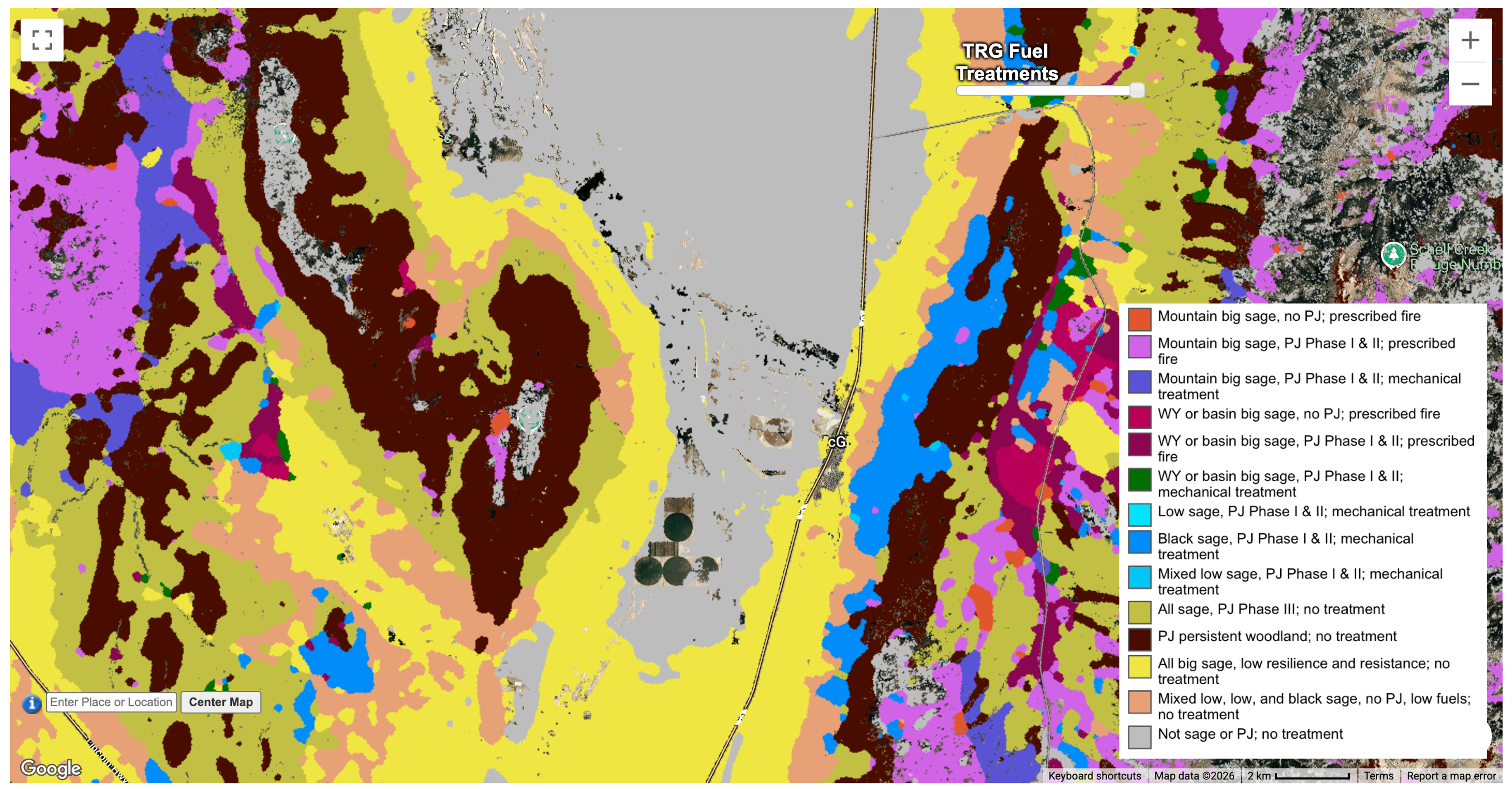
The Treatment Response Groups (TRG) Fuel Treatments dataset identifies sagebrush and pinyon-juniper vegetation associations with differing ecological responses to woody fuel treatments. TRGs integrate dominant sagebrush associations, the presence and phase of pinyon-juniper expansion, persistent pinyon-juniper woodlands, and climate-sensitive indicators of ecological resilience to disturbance and resistance to invasive annual grasses. Based on these characteristics and evidence from prior treatment studies, the dataset assigns potential prescribed fire, mechanical tree removal, or no-treatment categories.
The dataset was developed for the Central Basin and Range, Northern Basin and Range, and Snake River Plain level III ecoregions. The source TRG products are 30-meter raster datasets. Treatment assignments were intended to identify locations where woody fuel treatments are more likely to provide durable reductions in fire risk while maintaining or improving ecological resilience and resistance. Areas with low resilience or resistance, Phase III pinyon-juniper expansion, persistent pinyon-juniper woodlands, and some low-fuel sagebrush associations were generally assigned no treatment.
Organization
U.S. Department of Agriculture, Forest Service, Rocky Mountain Research Station (USDA Forest Service RMRS)
Website
Link to dataset on U.S. Forest Service Research Data Archive https://doi.org/10.2737/RDS-2024-0008
Terms of Use
The supporting publication is a U.S. Government work and is available under the Creative Commons Attribution 4.0 International License. Users should cite the source publication when using or interpreting the TRG Fuel Treatments dataset. The manuscript notes that the metadata and maps were submitted for publication in the USDA Research Data Archive. (CHECK ON THIS)
References
Chambers, J. C., Brown, J. L., Reeves, M. C., Strand, E. K., Ellsworth, L. M., Tortorelli, C. M., Urza, A. K., & Short, K. C. (2023). Fuel treatment response groups for fire-prone sagebrush landscapes. Fire Ecology, 19, 70. https://doi.org/10.1186/s42408-023-00230-2
Chambers, Jeanne C.; Brown, Jessi L.; Reeves, Matthew C.; Strand, Eva K.; Ellsworth, Lisa M.; Tortorelli, Claire M.; Urza, Alexandra K.; Short, Karen C. 2024. Treatment Response Groups (TRGs) for use in landscape-scale assessments of fuel treatment types and locations in the Snake River Plain, Northern Basin and Range, and Central Basin and Range level III ecoregions in the western United States. Fort Collins, CO: Forest Service Research Data Archive. https://doi.org/10.2737/RDS-2024-0008
Note:
-
Mountain big sage, no PJ; prescribed fire #E1562C
-
Mountain big sage, PJ Phase I & II; prescribed fire #D163E6
-
Mountain big sage, PJ Phase I & II; mechanical treatment #5954D6
-
WY or basin big sage, no PJ; prescribed fire #B80058
-
WY or basin big sage, PJ Phase I & II; prescribed fire #8A034F
-
WY or basin big sage, PJ Phase I & II; mechanical treatment #006E00
-
Low sage, PJ Phase I & II; mechanical treatment #00E3FF
-
Black sage, PJ Phase I & II; mechanical treatment #008CF9
-
Mixed low sage, PJ Phase I & II; mechanical treatment #00C6F8
-
All sage, PJ Phase III; no treatment #C2C044
-
PJ persistent woodland; no treatment #490D00
-
All big sage, low resilience and resistance; no treatment #EFE645
-
Mixed low, low, and black sage, no PJ, low fuels; no treatment #E6A176
-
Not sage or PJ; no treatment #BDBDBD